Description
Ivermectin 0.02% Oral Solution for Pet Birds (0.2 mg/mL, 55 mL): Mites, Worms and Lice
A bird scratching constantly, with crusty growths around the beak and eyes or scaly deposits on its legs, usually has parasites rather than an infection. So does a bird that wheezes and loses condition while its droppings stay normal. Those are problems an antibiotic will not touch.
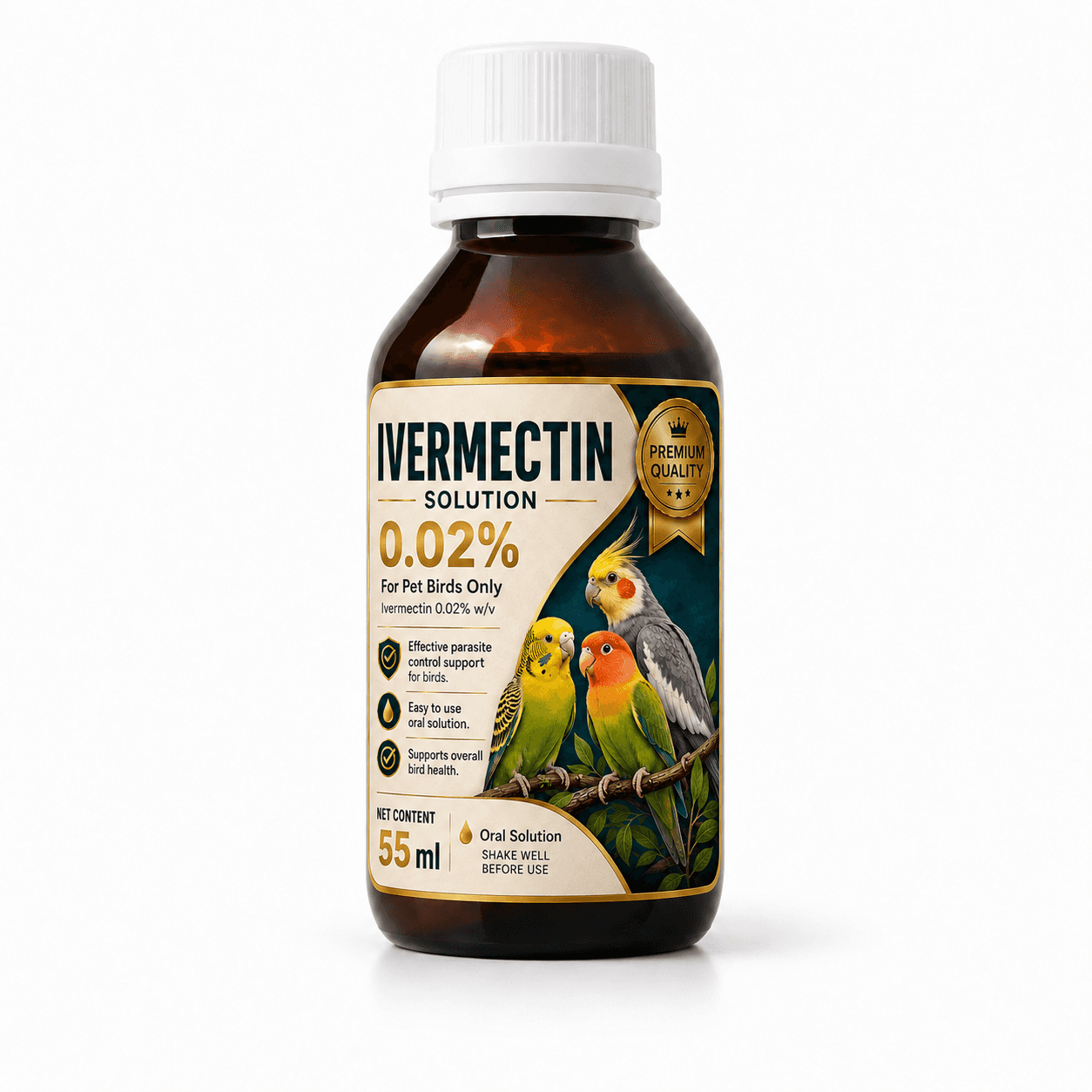
Ivermectin 0.02% Oral Solution contains ivermectin at 0.02% w/v — 0.2 mg per millilitre — in a 55 mL bottle labelled for pet birds only. Ivermectin is an avermectin antiparasitic, used for external and internal parasites including scaly face and leg mites, air sac mites, lice and roundworms.
This guide covers what the label states, why the dose has to come from your vet, how to tell a parasite problem from an infection, and when to seek help.
Important Notice: this product is for pet birds only. It is not for human use and not for poultry or other food-producing birds. Always consult a qualified avian veterinarian if you are unsure about diagnosis or treatment.
What Is Ivermectin 0.02% Oral Solution?
Ivermectin 0.02% Oral Solution is a ready-mixed antiparasitic liquid for pet birds. The label states ivermectin 0.02% w/v, a net content of 55 mL, and instructs that the bottle is shaken well before use.
0.02% w/v works out at 0.2 mg of ivermectin per millilitre. That is a deliberately dilute preparation: ivermectin doses for small birds are tiny, and a dilute solution makes them measurable. It is also why the shake-well instruction matters — an uneven bottle gives an uneven dose.
Ivermectin is not an antibiotic. It paralyses and kills susceptible parasites by acting on their nerve and muscle channels, and has no effect on bacteria, fungi or viruses.
Product Details at a Glance
| Attribute | Details |
|---|---|
| Active ingredient | Ivermectin |
| Concentration | 0.02% w/v (0.2 mg per mL) |
| Drug class | Avermectin antiparasitic |
| Mechanism | Acts on parasite nerve and muscle channels, paralysing and killing susceptible parasites |
| Formulation | Ready-mixed oral solution; shake well before use |
| Net content | 55 mL |
| Used for | Scaly face and leg mites, air sac mites, lice, roundworms including Capillaria |
| Not for | Bacterial, fungal or viral infections |
| Labelled for | Pet birds only |
| Regulatory status (USA) | Supplied over the counter for pet birds. Not an FDA-approved animal drug — see our legal and regulatory information |
| Storage | Cool, dry place out of direct sunlight; keep away from children and pets |
What Ivermectin 0.02% Oral Solution Is Used For
Ivermectin addresses parasites, not infections. The problems below are the ones bird keepers most often bring it out for — but identifying the parasite matters, because not every itch or wheeze is one.
Scaly face and scaly leg mites
Knemidokoptes mites burrow into the skin around the beak, eyes, vent and legs, producing the characteristic honeycombed crusts. Budgerigars are especially prone. The changes are slow and easy to dismiss early, and advanced cases can permanently deform the beak, so have a vet confirm it and treat promptly.
Air sac mites
Sternostoma tracheacolum live in the airways, and affected birds wheeze, click, tail-bob or breathe open-mouthed, often worse after exertion. Canaries and gouldian finches are particularly affected. Because those signs look like a respiratory infection, this is exactly the case where guessing wrong wastes time a struggling bird does not have.
Lice and feather mites
External parasites cause irritation, feather damage and restlessness. They are usually visible on close inspection of the feathers, particularly around the vent and under the wings.
Roundworms and Capillaria
Internal worms cause weight loss, poor condition and reduced performance in racing birds, often without dramatic signs. A faecal examination identifies which worms are present, and different worms respond to different actives — so confirm before and after treatment rather than assuming.
How Does Ivermectin 0.02% Oral Solution Work?
Ivermectin binds to glutamate-gated chloride channels in parasite nerve and muscle cells. That increases the flow of chloride ions, paralysing the parasite, which then dies. Vertebrates have far fewer of those channels in accessible tissue, which is the basis of the margin between a parasite dose and a harmful one.
That margin is narrower in a small bird than in a dog or a horse, and it is why the concentration here is low and the dose is a veterinary calculation rather than a guess.
Ivermectin 0.02% Oral Solution Dosage and Administration
The label states the concentration and the volume, and tells you to shake the bottle. It does not state a dose per bird, and with ivermectin that gap should be respected rather than filled in from a forum post.
| What the label states | Value |
|---|---|
| Concentration | Ivermectin 0.02% w/v (0.2 mg per mL) |
| Net content | 55 mL |
| Before use | Shake well, every time |
| Dose per bird | Not printed on the label — set by an avian veterinarian |
Why we do not publish a dose for this bottle. A liquid is dosed by the
individual bird’s body weight, and a budgerigar, a pigeon and a macaw differ by orders of
magnitude. The bottle prints its concentration so a veterinarian can calculate from it; it does
not print a figure you can apply to your bird without that calculation. Ask your avian
veterinarian for the volume, the frequency and the number of days, and write it down.
Measuring accurately
Use a graduated oral syringe and shake the bottle first. Ivermectin doses for birds are small and weight-based, the margin for error in a finch or budgerigar is narrow, and an unshaken bottle delivers an inconsistent concentration. Get the volume from your avian veterinarian for your bird’s weight and species, and write it down.
Safety, Side Effects, and Precautions
The dose margin is narrow in small birds
Ivermectin is well tolerated at a correct dose and harmful above it, and the gap is smaller for a 30-gram finch than for a pigeon. Species sensitivity also varies. This is the single strongest reason to get the volume from a veterinarian rather than scaling something you read for another animal.
Shake well before use
The label instructs it, and the reason is practical: if the ivermectin is not evenly distributed, one millilitre is not the same as the next. Shake every time, not just when the bottle is new.
Signs of overdose
Weakness, incoordination, unusual quietness, drooping or refusal to eat after a dose all warrant prompt veterinary contact. Do not give more in response to a bird that seems unwell after dosing.
It is not an antibiotic
Ivermectin does nothing against bacteria, fungi or viruses. A bird with an infection needs a different product, and treating a bacterial illness with an antiparasitic simply loses time.
Not for food-producing birds
This pack is labelled for pet birds. Do not use it in chickens, ducks, quail or turkeys kept for eggs or meat.
Treat the environment too
Mites and lice live in the cage, loft and nest material as well as on the bird. Ask your veterinarian about cleaning and repeat treatment intervals, or the birds are simply reinfected from their surroundings.
Storage and Shelf Life
Store the bottle in a cool, dry place out of direct sunlight and keep it away from children and pets. Check the lot number and expiry date printed on the pack before use. Keep the cap closed, and shake well before each dose.
Ivermectin 0.02% Oral Solution vs. Our Other Bird Medications
Ivermectin is the parasite product in our range. Everything else listed here is an antibacterial or antiprotozoal, which is the distinction that matters when a bird is wheezing: air sac mites and a respiratory infection look similar and need different treatments.
| Product | Active ingredient | Strength | Best for | When to choose |
|---|---|---|---|---|
| Ivermectin 0.02% Oral Solution (this product) | Ivermectin | 0.2 mg per mL | Scaly face and leg mites, air sac mites, lice, roundworms | An identified parasite problem |
| Vetafarm Trizole | Combination antiprotozoal | See pack | Canker, coccidiosis, giardia, hexamita | Protozoal problems, which antibiotics do not cover |
| All in One Powder | Blend of 5 actives, not named on the pack | Not stated | Canker, coccidiosis, respiratory and worm support | A loft programme on veterinary advice |
| Enrofloxacin 10% Powder | Enrofloxacin | 100 mg per gram | E. coli, Salmonella, Pasteurella, gram-negative infections | Flock or loft treatment through drinking water |
| Tylosin Powder | Tylosin tartrate | 99% (990 mg per gram) | Mycoplasma, chronic respiratory disease, sinusitis | Respiratory signs where Mycoplasma is suspected |
| Doxycycline 20% Powder | Doxycycline | 200 mg per gram | Psittacosis, Mycoplasma, bacterial respiratory infections | Suspected psittacosis |
| Doxy-Tyl Powder | Tylosin + doxycycline | 40% + 20% | Mixed respiratory infections, Chlamydia + Mycoplasma | When both organisms may be involved |
Our recommendation: Identify the parasite before treating. A wheezing bird may have air sac mites or a respiratory infection, and the two need completely different products — our guide to the antibacterial classes covers the antibacterial side. Where mites or worms are confirmed, ask your veterinarian for the volume and the repeat interval, and clean the environment at the same time.
Signs of Recovery and When to Seek Veterinary Help
What Recovery Looks Like
With mites, expect gradual improvement rather than an overnight change: scratching settles, crusts soften and lift over weeks, and new feather growth comes through clean. With air sac mites, breathing quietens and exercise tolerance improves. With worms, condition and weight recover. Repeat treatment is often needed to catch newly hatched parasites, which is a question for your vet rather than an assumption.
When to Seek Professional Help
Seek prompt help if a bird is weak, uncoordinated or refuses food after dosing, if breathing worsens, or if crusts and irritation continue despite treatment. A bird that is struggling to breathe needs assessment the same day.
Frequently Asked Questions About Ivermectin 0.02% Oral Solution
These answers cover what the label states, what it does not, and where a veterinarian has to make the call.
What is Ivermectin 0.02% Oral Solution for birds?
A ready-mixed antiparasitic liquid for pet birds containing ivermectin at 0.02% w/v, which is 0.2 mg per millilitre, in a 55 mL bottle. The label says to shake well before use.
How much should I give my bird?
The label states the concentration, not a dose. Ivermectin is dosed by body weight and the margin in a small bird is narrow, so the volume must come from an avian veterinarian who has weighed your bird. This is not a product to estimate.
What does it treat?
It is used for external and internal parasites in birds – scaly face and leg mites, air sac mites, lice, and roundworms including Capillaria. It is not an antibiotic and does nothing against bacterial infections.
Why does the label say shake well before use?
So the ivermectin is evenly distributed through the liquid. An unshaken bottle can give an inconsistent amount per millilitre, which matters when the dose is small. Shake it every time.
Can I use it at the same time as an antibiotic?
Parasites and bacteria are different problems, and a bird sometimes has both, but combining medications is a veterinary decision. Ask before running two products together.
Is ivermectin safe for all birds?
Species differ in sensitivity and the dose is weight-based, so a volume that suits a pigeon can be far too much for a finch. Have your avian veterinarian confirm both the product and the amount for your species.
What should I watch for after dosing?
Contact your veterinarian promptly if the bird becomes weak, uncoordinated, unusually quiet, or stops eating after a dose. Those are reasons to seek help rather than to give more.
Can this be used for chickens or other poultry?
No. This pack is labelled for pet birds only and must not be used in birds kept for eggs or meat.
Conclusion
Ivermectin 0.02% Oral Solution supplies ivermectin at 0.2 mg per millilitre in a 55 mL bottle labelled for pet birds, for scaly face and leg mites, air sac mites, lice and roundworms. It is not an antibiotic and does nothing against bacterial illness.
Shake the bottle before every dose, measure with a syringe, and get the volume and the repeat interval from an avian veterinarian who has weighed your bird. The margin between a correct dose and too much is narrow in small birds, which is the whole reason this page does not print a number.
Ready to treat? Ivermectin 0.02% Oral Solution, 0.2 mg/mL, 55 mL is in stock and dispatched the same day (Sunday to Friday) on orders placed before 5:00 PM ET, shipped tracked within the United States.
Related Products
These products have related or complementary roles.
- Vetafarm Trizole — for canker, coccidiosis and related protozoa.
- All in One Powder — a loft programme covering canker, coccidiosis, respiratory and worm concerns.
- Tylosin Powder — for suspected Mycoplasma respiratory signs, which can mimic air sac mites.
- Browse all bird antibiotics or read our guide to the antibacterial classes.
External Resources
Use these veterinary resources alongside advice for your individual bird.
- Association of Avian Veterinarians (AAV)
- American Veterinary Medical Association (AVMA)
- Merck Veterinary Manual
- FDA Center for Veterinary Medicine
Disclaimer: This page is general husbandry information, not veterinary advice and not a dosing instruction. This product is intended exclusively for the animals named on its label. It is not for human consumption and not for poultry or other food-producing birds. Consult a qualified avian veterinarian for diagnosis and treatment.
{“@context”: “https://schema.org”, “@type”: “FAQPage”, “mainEntity”: [{“@type”: “Question”, “name”: “What is Ivermectin 0.02% Oral Solution for birds?”, “acceptedAnswer”: {“@type”: “Answer”, “text”: “A ready-mixed antiparasitic liquid for pet birds containing ivermectin at 0.02% w/v, which is 0.2 mg per millilitre, in a 55 mL bottle. The label says to shake well before use.”}}, {“@type”: “Question”, “name”: “How much should I give my bird?”, “acceptedAnswer”: {“@type”: “Answer”, “text”: “The label states the concentration, not a dose. Ivermectin is dosed by body weight and the margin in a small bird is narrow, so the volume must come from an avian veterinarian who has weighed your bird. This is not a product to estimate.”}}, {“@type”: “Question”, “name”: “What does it treat?”, “acceptedAnswer”: {“@type”: “Answer”, “text”: “It is used for external and internal parasites in birds – scaly face and leg mites, air sac mites, lice, and roundworms including Capillaria. It is not an antibiotic and does nothing against bacterial infections.”}}, {“@type”: “Question”, “name”: “Why does the label say shake well before use?”, “acceptedAnswer”: {“@type”: “Answer”, “text”: “So the ivermectin is evenly distributed through the liquid. An unshaken bottle can give an inconsistent amount per millilitre, which matters when the dose is small. Shake it every time.”}}, {“@type”: “Question”, “name”: “Can I use it at the same time as an antibiotic?”, “acceptedAnswer”: {“@type”: “Answer”, “text”: “Parasites and bacteria are different problems, and a bird sometimes has both, but combining medications is a veterinary decision. Ask before running two products together.”}}, {“@type”: “Question”, “name”: “Is ivermectin safe for all birds?”, “acceptedAnswer”: {“@type”: “Answer”, “text”: “Species differ in sensitivity and the dose is weight-based, so a volume that suits a pigeon can be far too much for a finch. Have your avian veterinarian confirm both the product and the amount for your species.”}}, {“@type”: “Question”, “name”: “What should I watch for after dosing?”, “acceptedAnswer”: {“@type”: “Answer”, “text”: “Contact your veterinarian promptly if the bird becomes weak, uncoordinated, unusually quiet, or stops eating after a dose. Those are reasons to seek help rather than to give more.”}}, {“@type”: “Question”, “name”: “Can this be used for chickens or other poultry?”, “acceptedAnswer”: {“@type”: “Answer”, “text”: “No. This pack is labelled for pet birds only and must not be used in birds kept for eggs or meat.”}}]}
For pet and hobby birds only. Use under a veterinarian’s direction. Not for human use and not for birds or animals raised for food. Keep out of reach of children.



Reviews
There are no reviews yet.